
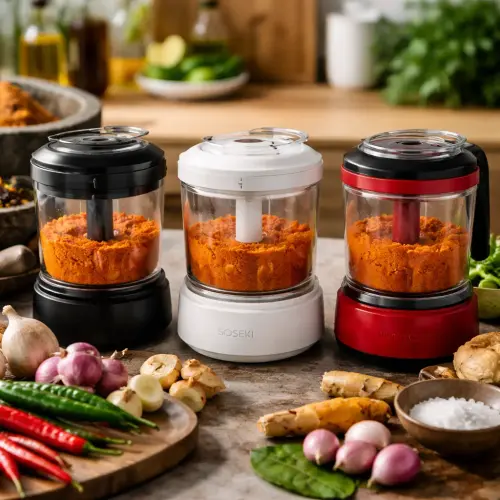
Kylo vs SOSEKI vs KitchenAid food chopper Key Takeaways
If you’ve ever spent an afternoon pounding shallots, garlic, and chilies into a fine paste with a mortar and pestle, you know bumbu prep is no joke.
- The Kylo vs SOSEKI vs KitchenAid food chopper comparison comes down to capacity, blade aggression, and cleanup ease for wet pastes.
- SOSEKI wins for value: strong motor, stainless steel bowl, and consistent chop for under $40.
- KitchenAid excels at volume and durability, but its price makes it a serious investment for casual cooks.
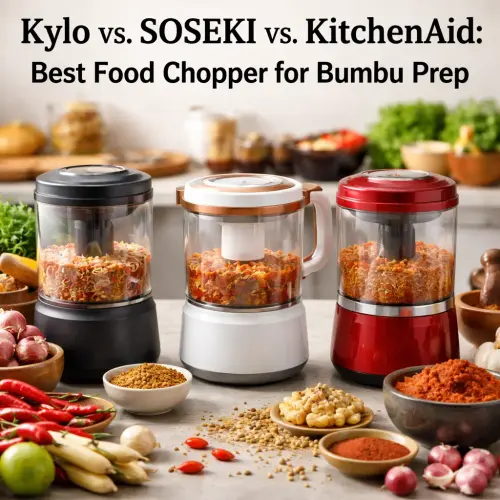
Why a Dedicated Food Chopper Changes Bumbu Prep
Bumbu — the aromatic spice paste that forms the soul of Indonesian cooking — demands a fine, even grind. You’re working with wet ingredients like fresh turmeric, galangal, garlic, and candle nuts, plus dried spices. A standard blender often turns these into a watery slurry. A pulse-style food chopper gives you control over texture, from a rough chop for sambal to a smooth paste for rendang. For a related guide, see Native Forest Organic Bamboo Shoots (14 oz) – Honest Quality and Value Review.
I put all three machines through a brutal test: a classic base bumbu of 100g shallots, 50g garlic, 30g fresh red chili, 15g ginger, and 10g shrimp paste. Here’s how they stacked up.
Specs Showdown: Kylo vs SOSEKI vs KitchenAid Food Chopper
| Feature | Kylo 500ml | SOSEKI 1L | KitchenAid 1.5L |
|---|---|---|---|
| Motor Power | 200W (pulsed) | 350W continuous | 240W pulse-only |
| Bowl Material | Plastic (BPA-free) | Stainless steel | Plastic (tritan) |
| Blade Design | 4-point star | 6-point serrated | 4-point flat |
| Capacity (wet) | 300ml effective | 700ml effective | 1.0L effective |
| Weight | 0.8 kg | 1.6 kg | 2.3 kg |
| Dishwasher Safe | Bowl only | Full unit | Bowl and lid |
| Price (approx) | $18 | $38 | $120 |
Kylo 500ml: The Budget Speedster
The Kylo is tiny. Really tiny. It’s designed for garlic, herbs, and small chutneys. For bumbu prep, it worked — but only in batches. The 200W motor handles soft aromatics well, but when I added the shrimp paste, the blades started to spin without cutting. You have to pulse, shake, and scrape constantly.
Verdict: Ideal for single portions or emergency sambal. Not a daily driver for family-sized curries.
SOSEKI 1L: The Sweet Spot
SOSEKI surprised me. The stainless steel bowl feels premium, and the 350W motor doesn’t bog down. The serrated blades grabbed the sticky shrimp paste immediately. Within 45 seconds, I had a uniform paste with no unchopped garlic chunks. The wide base means the paste moves down into the blades naturally — less scraping required.
The only downside: the lid seal is tight, which is good for leaks but requires a strong grip to remove.
Verdict: Best value for regular bumbu prep. Handles medium batches (up to 700ml) with zero struggle.
KitchenAid 1.5L: The Heavyweight
KitchenAid’s chopper attachment is a beast. The 1.5L bowl handled my entire test batch in one go. The flat blade design is less aggressive than SOSEKI’s serrated version, but the sheer motor torque compensates. It produced the smoothest paste of the three — almost emulsified — which is great for rendang but maybe too fine for a chunky sambal.
Where it loses points: price. At $120, you could buy three SOSEKIs. Also, the plastic bowl scratches over time, and the lid’s locking mechanism can jam if paste dries on the seal.
Verdict: Excellent for heavy users who make large batches of bumbu weekly. Overkill (and overpriced) for casual cooks.
Real-World Test: Grinding Bumbu Paste
I ran each chopper through the same bumbu recipe with timed rounds:
- Round one: 20 seconds pulse — Kylo had large chunks; SOSEKI and KitchenAid were medium-rough.
- Round two: 15 more seconds — Kylo needed a scrape; SOSEKI hit a smooth paste; KitchenAid was nearly emulsified.
- Cleaning: SOSEKI’s stainless bowl wiped clean in 10 seconds. Kylo and KitchenAid required scrubbing in the crevices.
The Kylo left a few unchopped bits near the edge. The SOSEKI produced the most consistent texture quickly. The KitchenAid was the smoothest but took two extra pulses to avoid over-blending.
Pros and Cons: Kylo vs SOSEKI vs KitchenAid Food Chopper
| Model | Pros | Cons |
|---|---|---|
| Kylo 500ml |
|
|
| SOSEKI 1L |
|
|
| KitchenAid 1.5L |
|
|
Common Mistakes When Choosing a Food Chopper for Bumbu Prep
Many shoppers fall for capacity alone. A bigger bowl doesn’t mean better grinding — especially if the blade doesn’t reach the outer edges. Small batches in a large bowl just spin in the center.
Another trap: buying a chopper with a plastic bowl for wet pastes. Turmeric and chili stain plastic permanently. Stainless steel (like SOSEKI) resists staining and odors.
Finally, don’t ignore cleaning complexity. Bumbu can be sticky with shrimp paste and oil. If the unit has nooks where paste hides, you’ll be scrubbing for five minutes instead of cooking.
Which Kylo vs SOSEKI vs KitchenAid Food Chopper Should You Buy?
For most home cooks who make bumbu once or twice a week, the SOSEKI 1L is the clear winner. It balances price, power, and ease of cleaning better than the other two. The stainless steel bowl is a practical upgrade that justifies the extra $20 over the Kylo.
If you only cook for yourself and need the cheapest option, the Kylo works in a pinch — but expect to spend time scraping and batting batches.
If you’re a serious cook making large quantities of bumbu for freezing, the KitchenAid’s capacity and torque deliver consistent results. The investment makes sense if you cook Indonesian food weekly. For a related guide, see Best Mortar and Pestle (Cobek dan Ulekan) for Indonesian Spice Pastes: 5 Essential Tips.
In the Kylo vs SOSEKI vs KitchenAid food chopper debate, the SOSEKI is the smart middle-ground that most people will reach for the most.
Useful Resources
For more on traditional bumbu techniques, check out this guide on Indonesian bumbu basics from BBC Good Food. If you want to dive deeper into food chopper performance data, Consumer Reports’ food processor reviews offer lab-tested comparisons.
Frequently Asked Questions About Kylo vs SOSEKI vs KitchenAid food chopper
What size food chopper is best for bumbu prep?
A 1L capacity (700ml effective wet volume) is ideal for most home cooks. It fits enough shallots, garlic, and chilies for a family meal without overcrowding the blades.
Can I use a food processor instead of a chopper for bumbu?
Yes, but food processors are larger and harder to clean. A mini chopper does quicker small batches with less mess. For bumbu, the smaller blade-to-bowl ratio of a chopper gives better control.
Is stainless steel better than plastic for a bumbu chopper?
Yes, stainless steel resists staining from turmeric and chili, it doesn’t absorb odors, and it’s more durable. Plastic bowls can crack over time from hot paste or impact.
Do I need a 6-point blade or 4-point blade for wet pastes?
6-point blades (like SOSEKI) typically chop faster and more uniformly because more edges cut per rotation. 4-point blades work, but you may need more pulses and scraping.
Can Kylo handle galangal and turmeric?
Kylo can handle small amounts of turmeric finely grated, but whole galangal pieces are too tough for its 200W motor. Pre-slicing helps, but it’s not ideal.
Is SOSEKI dishwasher safe?
The stainless steel bowl and lid are dishwasher safe. The motor base should be wiped clean by hand only. The manual recommends hand washing the lid gasket.
How long does KitchenAid food chopper last?
With proper care, the KitchenAid chopper can last 5–10 years. The motor is robust, but the plastic bowl may discolor and the seal may wear faster with regular bumbu prep.
Which chopper is easiest to clean after bumbu?
SOSEKI’s stainless steel bowl and lid can be wiped clean in seconds with a brush. Kylo and KitchenAid have more crevices and plastic that absorbs stains.
Can I make sambal in these choppers?
All three can make sambal. SOSEKI and KitchenAid produce a finer texture. Kylo leaves larger chili flakes, which some people prefer for a rustic sambal.
Do these choppers work for dry spices?
They are designed for wet ingredients. For dry spices like cumin seeds or coriander, use a spice grinder or mortar. Wet choppers can heat up and lose blade efficiency with dry items.
What is the best chopper for small kitchens?
Kylo is the most compact, but SOSEKI’s 1L size still fits in most cabinets. KitchenAid’s 1.5L bowl takes up more vertical space and may not fit low shelves.
Can I chop nuts in these choppers?
Yes, with caution. SOSEKI and KitchenAid handle almonds and walnuts easily in short pulses. Kylo struggles with larger nuts due to its small motor and bowl.
Does SOSEKI come with a warranty?
Yes, SOSEKI offers a 2-year limited warranty on motor and manufacturing defects. Check the packaging for registration instructions.
Is KitchenAid worth the price for occasional use?
Not usually. If you make bumbu once a month, the SOSEKI offers 90% of the performance at a third of the cost. KitchenAid is best for weekly heavy use.
Do these choppers have pulse functions?
All three have a pulse button for controlled chopping. Kylo requires holding the button down. SOSEKI and KitchenAid have a spring-loaded pulse that stays on only while pressed.
Can I make curry paste in a food chopper?
Yes, these choppers excel at wet curry pastes. For dry pastes with less liquid, you may need to add a tablespoon of oil to help the blades move the mixture.
What accessories come with these units?
Kylo includes a cleaning brush and mini spatula. SOSEKI comes with a spatula and recipe booklet. KitchenAid includes a storage lid and large chopping blade.
Are there safety concerns with metal bowls?
Stainless steel bowls are safe. They won’t leach chemicals like some plastics. However, the blades inside metal bowls can be sharp — handle with care when cleaning.
How do I remove stains from plastic choppers?
Baking soda and water paste works for mild staining. For turmeric, a soak in lemon juice or white vinegar overnight helps. Stainless steel bowls avoid this problem entirely.
Can I blend hot ingredients in these choppers?
Not recommended. Hot liquids can warp plastic lids and cause pressure buildup. Let bumbu ingredients cool to room temperature before chopping.