
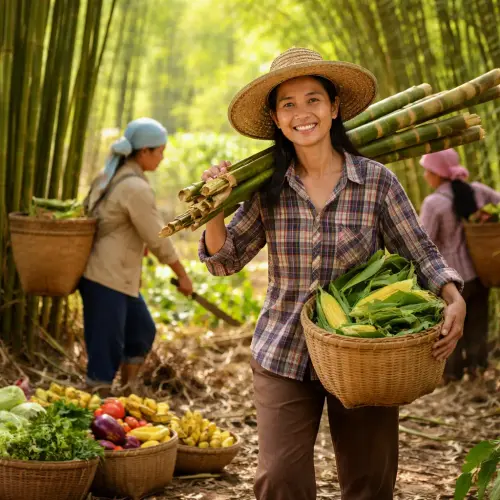
women bamboo harvesters family food security Key Takeaways
Across rural hillsides and river valleys, women bamboo harvesters are the quiet backbone of bamboo harvesting food security .
- Women bamboo harvesters manage the entire slope-to-stove cycle of bamboo shoots for family meals.
- Their income from bamboo crafts directly buffers families against food price shocks in local markets.
- Community cooperatives led by women strengthen long-term role of women in food security across entire regions.
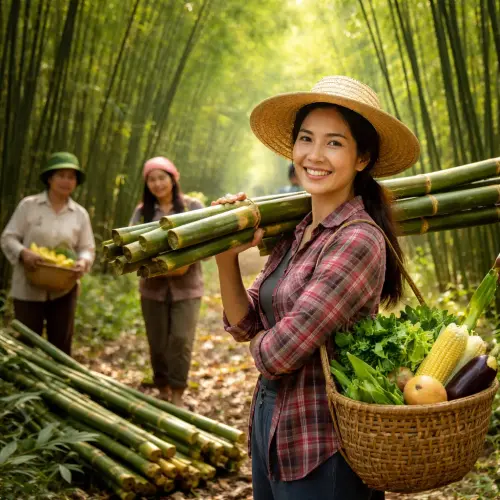
The Quiet Dawn of the Bamboo Harvest
Daybreak in the highlands of West Java. A light mist still clings to the clumps of Gigantochloa apus. Ibu Sari, 42, wraps a worn sarong around her waist, ties a sharp machete to her back, and steps into the grove behind her house. She is one of millions of women bamboo harvesters whose hands feed families across Asia, Africa, and Latin America.
This is not a job she chose for adventure. It is a lifeline. The bamboo grove is her pantry, her bank, and her insurance against hunger. The role of women in food security begins right here, on the damp forest floor, before the sun climbs.
For Ibu Sari and her neighbors, bamboo is not just a construction material. It is a year-round source of food, cash, and resilience.
How Women Bamboo Harvesters Bolster Women Bamboo Harvesters Family Food Security
When we talk about women bamboo harvesters family food security, we are really talking about a system of knowledge, timing, and sacrifice. These women are not just collectors. They are strategists.
Knowledge of the Groves
Women know which shoots are edible at each growth stage. They know that young shoots picked too early are bitter, while those left two days too long turn woody. This timing is everything. A skilled harvester can identify the perfect shoot within seconds—a skill passed from mother to daughter over generations.
This knowledge directly feeds households. In many rural communities, bamboo shoots are a staple vegetable during the monsoon season when other greens are scarce. The bamboo harvesting food security connection is literal: one mature clump can produce 20 to 30 kilograms of edible shoots per year. For a related guide, see Lumajang-Style Lodeh Rebung: 7 Easy Tips for a Creamier, Spicier Dish.
From Forest to Kitchen Table
The journey from grove to dinner plate is swift. Women bamboo harvesters often process the shoots the same day they are cut. They peel the tough outer layers, slice the tender inner core, and boil it to remove bitterness. This is not just cooking; it is an act of food preservation. Boiled bamboo shoots can be stored for days or fermented into traditional pickles that last for months.
This rapid transformation ensures that the family eats protein-rich, fiber-dense food even when other income is low. That is the core of women bamboo harvesters family food security: turning wild resources into dependable meals.
The Economic Engine That Feeds the Family
Beyond direct consumption, women bamboo harvesters are the economic engine of many rural households. They sell raw shoots at local markets, dried bamboo strips for crafts, and woven baskets made from mature culms. The income from these activities is often the only cash that enters the home.
In a 2023 study by the International Bamboo and Rattan Organisation (INBAR), researchers found that women-led bamboo enterprises contribute up to 35 percent of household income in bamboo-rich regions of India and Nepal. That money buys rice, cooking oil, medicine, and school fees. When a mother controls that income, studies show that children are 24 percent more likely to eat three meals a day.
Savings Groups and Food Reserves
Many women bamboo harvesters form small savings and credit groups. They pool a portion of their weekly earnings to create a community food fund. When a family faces a crisis—crop failure, illness, or a price spike—they can draw from this fund. This is a direct example of the role of women in food security that goes unseen by outsiders. It is cooperative, local, and remarkably effective.
| Role of Women Bamboo Harvesters | Direct Impact on Family Food Security |
|---|---|
| Shoot harvesting | Provides fresh vegetable protein for 6–8 months per year |
| Craft making (baskets, trays) | Generates steady cash income for purchasing staples |
| Preserving (drying, pickling) | Extends food availability into lean seasons |
| Cooperative leadership | Creates collective food safety nets and price negotiation power |
| Knowledge transfer | Teaches daughters sustainable harvesting, ensuring future food access |
Why This Story Is Still Untold
The bamboo harvesting food security narrative is often missing from mainstream agriculture discussions. Governments and NGOs regularly focus on rice, wheat, and maize—the big three. Meanwhile, bamboo is dismissed as a minor forest product. But for women like Ibu Sari, bamboo is not minor. It is major.
One reason this blind spot persists is that women’s labor in informal economies is rarely counted. National surveys often miss the time women spend collecting forest foods or selling handcrafts. The role of women in food security remains statistically invisible, which means it is also invisible in policy and investment.
There is also a social factor. In many cultures, women are expected to manage household food needs but are not recognized as producers. When development programs design interventions, they often speak to men about cash crops and ignore women’s deep knowledge of forest foods. That is a costly mistake.
Community Resilience in the Face of Climate Change
Climate change is making food systems more fragile. Droughts, erratic rainfall, and soil degradation hit smallholder farmers hardest. Bamboo is remarkably resilient. It grows on degraded slopes, requires no chemical fertilizer, and regenerates quickly after harvest. Women bamboo harvesters are therefore on the front lines of climate adaptation.
They are the ones who know which bamboo species survive drought. They hold the traditional knowledge of intercropping bamboo with vegetables and root crops. In many communities, the bamboo grove is the last source of food when everything else fails. This is a powerful, yet still undervalued, dimension of women bamboo harvesters family food security.
Common Misconceptions About Women Bamboo Harvesters
A frequent assumption is that bamboo harvesting is low-skill, low-value work. That could not be further from the truth. Selecting the right shoots requires years of experience. Cutting mature culms at the correct lunar phase and age affects their strength. Weaving with split bamboo demands precision that takes a decade to master. For a related guide, see 7 Surprising Benefits: Harvesting Bamboo Shoots Makes Bamboo Grow Better.
Another misconception is that women only assist men in bamboo work. In reality, women are the primary harvesters, processors, and traders of bamboo shoots and small crafts in many regions. Men often cut larger culms for construction, but women control the food-related parts of the value chain. That distinction is crucial for understanding the role of women in food security.
Finally, there is a myth that bamboo shoots are just a wild food, not a reliable dietary staple. In fact, bamboo shoots are rich in fiber, low in fat, and contain significant amounts of potassium, vitamin B6, and copper. They are a legitimate nutritional resource that deserves greater recognition in food security frameworks.
Useful Resources
For a deeper look at bamboo’s potential in sustainable development, visit the International Bamboo and Rattan Organisation (INBAR), which publishes policy briefs and case studies on bamboo and gender.
To read more about women’s hidden contributions to forest-based food systems, see this CIFOR report on gender and non-timber forest products.
Conclusion: The Lasting Impact of Women Bamboo Harvesters on Family Food Security
As the late afternoon sun filters through the bamboo grove, Ibu Sari finally straightens her back. Her basket is full. Tonight, her family will eat a stir-fry of bamboo shoots with chili and shrimp paste. Tomorrow, she will weave a few baskets to sell at the market. The week after next, her cooperative will meet to plan the community food fund.
This is not a small story. The women bamboo harvesters family food security framework is a model of resilience, resourcefulness, and quiet strength. It deserves to be told, understood, and supported. When we invest in the women who harvest bamboo, we are not just funding crafts or shoots. We are feeding families, stabilizing communities, and building a more secure food future for everyone.
Frequently Asked Questions About women bamboo harvesters family food security
How do women bamboo harvesters contribute to family nutrition?
They harvest edible bamboo shoots that provide dietary fiber, protein, and key vitamins during lean seasons when other vegetables are unavailable.
What is bamboo harvesting food security ?
It is the concept that sustainable harvesting of bamboo shoots and culms provides both direct food and income that strengthens household food access year-round.
Are bamboo shoots nutritionally valuable?
Yes, bamboo shoots are high in dietary fiber, low in calories, and a good source of vitamin B6, potassium, and copper, making them a healthy complement to rice and legumes.
What is the role of women in food security specifically in bamboo regions?
Women are the primary harvesters, processors, and sellers of bamboo shoots and crafts, controlling the food and income generated from bamboo groves within their households.
Do women bamboo harvesters face gender-specific challenges?
Yes, they often lack land tenure security, access to credit, and recognition in agricultural policy, even though they carry most of the harvesting and processing workload.
How does bamboo harvesting affect household income?
Bamboo-related activities can contribute up to 35 percent of household income in rural areas, particularly through the sale of shoots and woven products.
What are the most common bamboo species harvested for food?
Species like Gigantochloa apus, Bambusa vulgaris, and Dendrocalamus asper are commonly harvested for their edible shoots in South and Southeast Asia.
How do women preserve bamboo shoots for later use?
They boil, dry, ferment, or pickle bamboo shoots to extend shelf life, ensuring their families have food during off-seasons or in times of scarcity.
Is bamboo harvesting sustainable for food security?
When done with traditional knowledge, bamboo harvesting is highly sustainable because clumps regenerate quickly, soil erosion is minimized, and no chemical inputs are needed.
What is the economic value of bamboo shoots compared to other vegetables?
In local markets, bamboo shoots often fetch a lower price than exotic vegetables, but they are far more reliable and available, reducing household food expenditure over time.
Why is the role of women in food security often overlooked?
Much of women’s bamboo work is informal and uncounted in national statistics, and development projects tend to prioritize men’s crops and men’s income streams.
What skills do women bamboo harvesters pass to younger generations?
They teach shoot identification, timing of harvest, cutting techniques, processing methods, and weaving—skills that secure both food and livelihood continuity.
How does bamboo compare to other crops in drought-prone areas?
Bamboo roots bind soil and retain moisture better than many annual crops, making groves more resilient during droughts and ensuring food remains available.
Can bamboo harvesting reduce family food insecurity in urban areas?
Yes, urban women in peri-urban bamboo groves also rely on this resource, though they face additional pressures from land conversion and market competition.
What policies could better support women bamboo harvesters ?
Policies that provide secure land tenure, access to microcredit, training in value-added processing, and inclusion in national food security programs would make a significant difference.
Do men or women control bamboo income in most households?
Women typically control the income from bamboo shoots and small crafts, which they use primarily for food and children’s needs, while men manage large timber bamboo sales.
How does climate change affect women bamboo harvesters ?
Shifts in rainfall and temperature alter shoot growth patterns, requiring women to adjust their harvesting calendars and rely even more on their traditional ecological knowledge.
What is an example of women’s collective action in bamboo communities?
In several villages in Odisha, India, women bamboo harvesters formed a cooperative that sets fair prices, shares transportation costs, and maintains a community food reserve for emergencies.
Are bamboo shoots safe for everyone to eat?
Raw bamboo shoots contain cyanogenic glycosides that must be removed through proper boiling or fermentation, which women harvesters have learned to do safely through generations of practice.
How can readers support women bamboo harvesters ?
Readers can support fair-trade bamboo products, donate to women’s bamboo cooperatives, advocate for inclusive agricultural policies, and share stories that highlight the role of women in food security.