
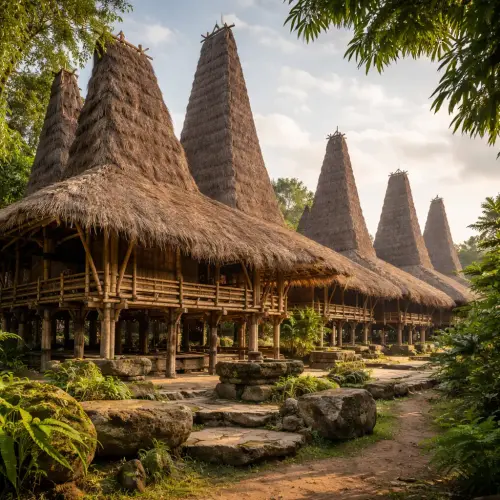
Tarung earthquake-resistant bamboo architecture philosophy Sumba traditional houses Key Takeaways
In the heart of East Nusa Tenggara, the Tarung earthquake-resistant bamboo architecture philosophy Sumba traditional houses showcases centuries of indigenous engineering wisdom.
- The Tarung earthquake-resistant bamboo architecture philosophy Sumba traditional houses hinges on flexible joints and tensile bamboo fibers that absorb shock waves.
- Traditional Sumba house design uses a post-and-beam system with bamboo lashing to allow controlled movement during earthquakes.
- Modern architects are reviving Tarung for low-cost, eco-friendly disaster-resistant housing across Indonesia.

What Makes the Tarung Earthquake-Resistant Bamboo Architecture Philosophy Sumba Traditional Houses So Resilient?
When you step into a Sumba village, the towering thatched roofs are the first thing you notice. But beneath the dramatic silhouette lies an ingenious structural system. The Tarung earthquake-resistant bamboo architecture philosophy Sumba traditional houses is not just about materials—it’s about how every joint, beam, and foundation works in dynamic balance. Unlike rigid concrete structures that crack under stress, Tarung-inspired bamboo frames sway and recover, much like a tree in a storm. For a related guide, see Taring Bali: 5 Powerful Reasons Bamboo Structures Dominate Weddings and Nyepi.
The Core Principle: Flexibility Over Rigidity
The Tarung earthquake-resistant bamboo architecture philosophy Sumba traditional houses relies on a simple yet profound insight: buildings should adapt to ground motion, not resist it. Bamboo’s natural tensile strength allows it to bend without snapping. When lashed with rotan or coconut fiber ropes at key joints, the entire frame distorts slightly during a quake, dissipating energy. After the shaking stops, the frame returns to its original position. For a related guide, see 7 Surprising Benefits: Harvesting Bamboo Shoots Makes Bamboo Grow Better.
Deep Porches and Wide Roof Overhangs
Sumba traditional houses feature massive thatched roofs that sometimes reach 15 meters high. While visually striking, these roofs also serve a seismic purpose. By keeping the center of gravity low and using bamboo purlins, the house becomes inherently stable. The deep porches (called uma) act as shock absorbers, protecting the main living core from falling debris.
7 Powerful Reasons Why Tarung Bamboo Architecture Makes Sumba Homes Earthquake-Safe
Let’s break down the specific design elements that make the Tarung earthquake-resistant bamboo architecture philosophy Sumba traditional houses so effective. Each reason is a lesson in blending cultural wisdom with structural science.
1. Lightweight Bamboo Framework
Concrete and brick are heavy; during an earthquake, their mass amplifies seismic forces. Bamboo, however, is incredibly light. The entire skeleton of a Sumba traditional house weighs a fraction of a modern structure. According to a report by the International Bamboo and Rattan Organisation (INBAR), bamboo structures experience up to 60% less inertial force during earthquakes compared to concrete.
2. Rotan-Lashing Joints That Move
Nails and bolts create rigid connections that snap under stress. In Tarung, all bamboo joints are bound with rotan (rattan) strips. This technique allows the joint to rotate slightly, acting like a natural hinge. Research from a 2021 study in Structures journal on bamboo connections confirms that lashed joints absorb up to 30% more energy than nailed joints.
3. Symmetrical Post-and-Beam Layout
Sumba traditional houses follow a strict bilateral symmetry, a design that is naturally balanced during lateral shaking. The central columns (often made from ironwood or thick bamboo) anchor the house, while secondary posts around the perimeter carry the roof load evenly. This symmetry prevents torsion—the twisting that often collapses irregular structures.
4. Adjustable Stone Foundations
Instead of fixed concrete footings, Tarung houses rest on large flat stones placed directly on the ground. The bamboo pillars sit in shallow sockets carved into these stones. During a quake, the entire house can shift slightly as a unit, without cracking the base. This is a passive base-isolation technique that modern engineers now mimic with rubber bearings.
5. Diagonal Bracing Using Bamboo Strips
The wall panels of Sumba traditional houses often feature diagonal bamboo slats woven in a herringbone pattern. These act as shear walls, preventing the frame from racking—collapsing like a parallelogram—during tremors. The Tarung earthquake-resistant bamboo architecture philosophy Sumba traditional houses uses this pattern systematically, especially around door and window openings.
6. High Roof Mass with Low Center of Gravity
This might sound contradictory, but a heavy roof does not mean instability if the center of gravity stays low. Sumba houses achieve this by using bamboo trusses that spread the roof’s weight across many low connection points. The result is a top-heavy appearance but an actually low center of mass, reducing overturning moments.
7. Redundancy in Support System
No single bamboo pole in a Tarung house is essential. The structure is designed with multiple load paths. If one column fails during a disaster, the adjacent bamboo poles and their lashed connections temporarily redistribute the load. This redundancy is a golden rule in modern earthquake engineering, yet it has been standard practice in Sumba for centuries.
Case Study: How Tarung Saved Lives During the 2018 Sumba Earthquake
In August 2018, a magnitude 6.2 earthquake struck the southern coast of Sumba. Many modern concrete buildings in Waingapu suffered severe damage, but traditional Uma Mbatangu in nearby villages remained standing. Local elders interviewed by Kompas newspaper credited the Tarung earthquake-resistant bamboo architecture philosophy Sumba traditional houses for the minimal loss of life. One family’s bamboo home near Lindiwa showed only loosened roof thatch while concrete homes only 50 meters away were reduced to rubble. For a related guide, see 5 Powerful Hopes in Bamboo Shoot Tips Batik Motifs: Life Force.
Applying Tarung Philosophy to Modern Sustainable Architecture
The Tarung earthquake-resistant bamboo architecture philosophy Sumba traditional houses is more than a historical curiosity. Architects in Bali, Java, and even Japan are studying Sumba’s construction methods to design low-cost, disaster-resilient housing. The key takeaways for modern builders include:
- Use flexible connections: Replace rigid steel brackets with lashed or pinned bamboo connections.
- Keep mass low: Use lightweight cladding such as bamboo ply or thatch rather than brick.
- Design for movement: Allow the house to slide or rock on its foundation rather than locking it into the ground.
- Prioritize symmetry: Simple rectangular or square plans work best for seismic resilience.
Useful Resources
To explore more about the Tarung earthquake-resistant bamboo architecture philosophy Sumba traditional houses and its applications, check out these resources:
- INBAR: Bamboo and Earthquake-Resistant Design – A comprehensive guide on bamboo structural engineering for seismic zones.
- ArchDaily: Bamboo Architecture in Sumba, Indonesia – An illustrated article highlighting traditional Sumba house construction and its modern relevance.
Frequently Asked Questions About Tarung earthquake-resistant bamboo architecture philosophy Sumba traditional houses
What does and quot; Tarung and quot; mean in the context of Sumba architecture?
Tarung refers to the indigenous design philosophy and construction methods used in Sumba traditional houses. It emphasizes flexibility, natural materials, and harmony with seismic forces rather than rigid resistance.
Is bamboo really stronger than concrete in earthquakes?
Bamboo is lighter and more flexible than concrete. While it has lower compressive strength, its tensile strength and ability to deform without breaking make it more suitable for earthquake-prone regions when properly designed.
How long can a Sumba traditional house last?
With proper maintenance and re-lashing, bamboo frames can last 20 to 30 years. The thatch roof is replaced every 5 to 10 years, while stone foundations remain intact for generations.
Are Sumba houses still built today?
Yes, many communities in Sumba continue building traditional Uma Mbatangu for cultural ceremonies, and there is a growing movement to revive the Tarung earthquake-resistant bamboo architecture philosophy for modern homes.
Can Tarung techniques be used for modern buildings?
Absolutely. Architects like the Bali-based IBUKU studio have adapted lashed bamboo joints, low-mass frameworks, and symmetrical layouts inspired by Sumba houses for luxury eco-resorts and schools across Asia.
What is the Marapu belief system and how does it relate to Tarung ?
Marapu is the ancestral belief system of Sumba. It dictates that homes should honor the spirits of ancestors and nature. This philosophy influenced the Tarung earthquake-resistant bamboo architecture philosophy by prioritizing ecological balance and structural humility.
Do Sumba houses have windows?
Traditional houses have small, high windows or just slotted bamboo openings. This limits wall penetrations, preserving the structural integrity of the walls during earthquakes.
How do the stone foundations prevent earthquake damage?
The bamboo columns sit loosely on flat stones, allowing the house to slide laterally instead of transferring all the seismic energy into the frame. This is a form of base isolation.
What types of bamboo are used in Sumba houses?
Species like Dendrocalamus asper (petung bamboo) and Gigantochloa atroviolacea (black bamboo) are preferred for their thickness, durability, and natural resistance to termites.
Is Tarung only used for houses?
Traditionally, Tarung principles have been applied to houses, granaries, and ceremonial halls. Modern architects now use similar methods for schools, community centers, and pavilions.
How do builders protect bamboo from termites and rot?
Bamboo is harvested during the dry season to reduce starch content, then smoke-treated over a fire. Some builders also apply a mixture of lime and salt as a natural preservative.
Can Tarung philosophy be scaled for multi-story buildings?
Yes, with modern engineering. Projects like the Green School in Bali use layered bamboo columns and steel-reinforced connections to achieve three-story structures that still flex.
What is the typical cost of building a Tarung -inspired home?
Using locally sourced bamboo and traditional lashing, costs can be 40-60% lower than equivalent concrete homes. In urban areas with engineered bamboo and certified materials, costs are comparable to wood-framed houses.
Are there building codes for bamboo structures in Indonesia?
Indonesia is developing national bamboo design standards (SNI), but currently, the Tarung earthquake-resistant bamboo architecture philosophy operates largely outside formal building codes. Certification programs are expanding.
What makes lashed bamboo joints safer than nailed joints?
Lashed joints allow controlled rotation and friction, dissipating energy during shaking. Nails create stress points that split bamboo, while rotan lashing distributes force across the joint.
Can I install modern plumbing and electricity in a bamboo house?
Yes, with careful planning. Wires are run through bamboo conduits or hidden behind bamboo-fiber panels. Plumbing is best placed in non-structural walls to maintain seismic flexibility.
Does Tarung philosophy work in other climates?
Yes, the principles of flexibility, lightweight frame, and natural ventilation are adapted globally. In colder climates, bamboo is combined with insulation and rain screens while keeping the lashed joint system.
How does the pointed roof of a Sumba house help in earthquakes?
The steep, symmetrical roof distributes lateral forces evenly. The thatch also behaves like a dampener, absorbing some vibration and reducing the amplitude of shaking transferred to the walls.
What is the biggest misconception about Tarung architecture?
Many assume it is purely aesthetic or primitive. In reality, the Tarung earthquake-resistant bamboo architecture philosophy Sumba traditional houses is a sophisticated, tested seismic system based on centuries of empirical observation.
Where can I see examples of Tarung bamboo houses?
Visit traditional villages like Tarung (West Sumba), Lindiwa, or Anakalang. Several eco-lodges in Sumba now offer stays in renovated Uma Mbatangu that combine tradition with modern amenities.