
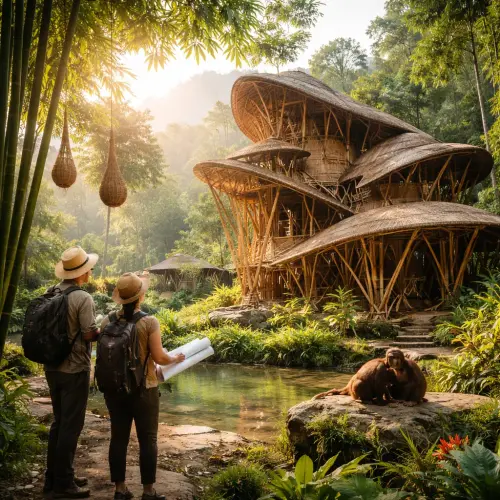
bamboo buildings Key Takeaways
The most innovative architects of tomorrow might not have diplomas — they build with wind, water, and instinct.
- bamboo buildings offer carbon-negative, earthquake-resistant structures that can be harvested in 3–5 years.
- Wild architects — from termite mounds to spider webs — teach us lessons in ventilation, strength, and material efficiency.
- Real-world projects in Colombia, Indonesia, and Germany already combine traditional bamboo craftsmanship with biomimetic design.
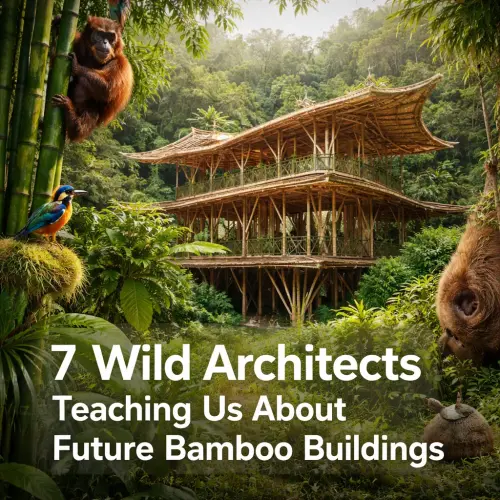
What Wild Architects Teach Us About Natural Building Design
When you watch a weaverbird stitch its nest from palm fronds, or see a beaver dam withstand a spring flood, you are looking at the work of a wild architect. These creatures have been perfecting sustainable building materials and structural strategies for millions of years. Human architects are now realizing that the future of bamboo buildings lies in copying nature’s time-tested tricks.
Bamboo itself is a wild architect’s dream. It grows up to 35 inches per day, requires no replanting, and sequesters four times more CO₂ than the same area of timber. But the real magic happens when we let nature guide how we shape it.
The Termite Mound Model for Natural Ventilation
Termite mounds in Africa maintain a steady 86°F inside, even when outside temperatures hit 104°F. The secret is a network of tunnels that channel air through convection. Architects in Zimbabwe copied this for the Eastgate Centre in Harare, reducing cooling energy by 90%. Now designers are applying the same principle to bamboo buildings, using hollow bamboo poles as natural air ducts. For a related guide, see 7 Surprising Benefits: Harvesting Bamboo Shoots Makes Bamboo Grow Better.
Spider Silk as a Blueprint for Bamboo Connections
Spider silk is stronger than steel and more elastic than nylon. Researchers at the University of Cambridge have developed bamboo joints inspired by spider silk’s molecular structure. These connectors allow bamboo architecture to flex during earthquakes without cracking — a lesson straight from the orb-weaver’s web.
7 Real-World Bamboo Buildings Inspired by Nature
From the jungles of Bali to the rice terraces of the Philippines, architects are taking cues from wild builders. Here are seven standout examples that prove bamboo buildings are not just eco-friendly — they are smart, durable, and breathtaking.
1. Green School, Bali — The Weaverbird’s Lesson
The Green School campus features a massive bamboo span of 19 meters — the longest in Southeast Asia. The curved, interlaced roof mimics a weaverbird’s nest. It uses no steel, no concrete, and stays cool through natural cross-ventilation. The structure proves that sustainable building materials can create iconic public spaces. For a related guide, see 5 Easy Tips for Sustainable Wild Rebung Foraging in the Forest.
2. Bamboo Living Pavilion, Colombia — The Ant Colony Approach
Architect Simón Vélez designed this pavilion using a technique called “bahareque” — a mud-and-bamboo composite that mimics the load-bearing walls of leafcutter ant nests. The result is a building that regulates humidity and temperature without air conditioning.
3. The Arc, Singapore — The Spider Web Connectors
This bamboo event space uses custom spider-web-inspired joints made from recycled bamboo纤维. The flexible grid survived a monsoon season with zero structural damage. It’s a prime example of how future bamboo buildings can thrive in tropical climates.
4. Casa de Bambu, Costa Rica — The Beaver Dam’s Water Management
Built entirely from locally sourced bamboo, this home channels rainwater through hollow stems into a collection tank. The design copies the way beavers build dams to manage water flow. It achieves net-zero water consumption.
5. Bamboo Cathedral, Philippines — The Coral Reef’s Strength
In San Felipe, a community-built cathedral uses layered bamboo bundles that mimic coral’s fractal branching. This distributes stress evenly, allowing the 12-meter-tall structure to withstand typhoons. It is one of the most resilient bamboo buildings in the world.
6. Bamboo Skywalk, Germany — The Bird’s Nest Cantilevers
In the Stuttgart Botanical Garden, a bamboo walkway extends 8 meters over a pond without supports. The cantilever design borrows from the woven nests of the European penduline tit. It demonstrates that bamboo architecture can achieve dramatic spans with minimal material.
7. The Bamboo Ring, Japan — The Mushroom’s Mycelium Root
Architect Kengo Kuma designed a circular bamboo pavilion that uses root-like foundations to grip the soil. Inspired by mycelium networks, the foundation spreads horizontally rather than digging deep. This makes it ideal for earthquake-prone regions — a key insight for the future of bamboo buildings.
How to Choose the Right Approach for Your Own Bamboo Building
You don’t need to be a licensed architect to start using these principles. Whether you are building a garden shed or a community center, follow this quick checklist adapted from wild architects.
Step 1: Study Your Local Climate and Site
Wild architects don’t fight their environment — they use it. If your site is windy, study termite mounds for ventilation. If it floods, look at beaver dam water management. Always orient your bamboo buildings to capture natural light and breeze.
Step 2: Choose the Right Bamboo Species
Not all bamboo is the same. Dendrocalamus asper offers high-density timber quality. Guadua angustifolia is known for earthquake resistance. Phyllostachys edulis (Moso) grows fast and is great for structural beams. Consult local suppliers to match the species to your design.
Step 3: Mimic Nature’s Connections
A bamboo building is only as strong as its joints. Avoid metal bolts that rust and cause splitting. Instead, use traditional lashing (rattan or hemp) or modern spider-silk-inspired connectors. These allow the structure to flex without breaking.
Step 4: Test With Small Prototypes
Before building full-scale, build a 1:10 model and stress-test it. Wild architects iterate constantly — a bird might rebuild its nest three times before it’s perfect. Do the same with your sustainable building materials.
Common Mistakes When Building With Bamboo
Even with nature as a guide, human builders make errors. Here are the top three pitfalls to avoid.
Treating Bamboo Incorrectly
Untreated bamboo rots in 2–3 years. For lasting bamboo architecture, use borate treatment or smoke curing. Avoid pressure treating with toxic chemicals — it defeats the purpose of sustainable design.
Ignoring the Sun’s Path
Wild builders always account for solar angles. If you place a bamboo building with windows facing west without shade, it will overheat. Study the sun’s arc on your site and design overhangs or living green walls to block harsh rays.
Using Too Much Concrete
A common mistake is building thick concrete foundations for lightweight bamboo. This wastes material and defeats the carbon-negative goal. Instead, use root-inspired shallow foundations or bamboo piling.
Useful Resources
To explore more about bamboo architecture and biomimetic design, check these expert sources:
- ArchDaily’s Bamboo Architecture Collection — case studies, drawings, and technical details from projects worldwide.
- International Bamboo and Rattan Organisation (INBAR) — research papers and building codes for sustainable building materials.
Frequently Asked Questions About bamboo buildings
How long do bamboo buildings last?
With proper treatment and maintenance, a well-built bamboo structure can last 50 to 100 years. The key is using treated bamboo, elevated foundations, and regular inspections for moisture damage.
Are bamboo buildings safe in earthquakes?
Yes. Bamboo is naturally flexible and lightweight, which allows it to absorb seismic energy better than concrete or brick. Many modern bamboo buildings in countries like Colombia and Japan have survived major earthquakes with minimal damage.
What is a ‘wild architect’?
A wild architect is any non-human organism that creates a structured habitat — birds, termites, spiders, beavers, and even fungi. Their building methods are highly efficient, sustainable, and often inspire human bamboo architecture through biomimicry.
Can bamboo buildings be fire-resistant?
Bamboo can be treated with fire-retardant chemicals, and thick bamboo poles naturally char on the outside, slowing combustion. However, untreated bamboo is flammable. Always consult local fire codes and use fire-resistant treatments for safety.
Is bamboo stronger than steel?
Bamboo has a tensile strength comparable to some grades of steel, but it is much lighter. A bamboo pole can support up to 2,000 pounds per square inch. This strength-to-weight ratio is what makes sustainable building materials like bamboo so attractive.
How much does a bamboo building cost?
Costs vary widely by region, but a basic bamboo house can cost 30–50% less than a conventional timber frame house. High-end bamboo buildings with custom joints and finishes may be comparable to modern construction. Labor costs for skilled bamboo craftsmen can be a significant factor.
What are the best bamboo species for construction?
Guadua (Latin America), Dendrocalamus asper (Asia), and Moso (China, Japan) are the most commonly used for structural bamboo architecture. Each has different properties: Guadua is very strong, Dendrocalamus is fast-growing, and Moso is widely available.
Do bamboo buildings need foundations?
Yes, but the foundation can be shallow and lightweight. Many bamboo buildings use raised concrete or stone pillars to keep the bamboo off the ground, preventing moisture damage. Root-like spreading foundations are also used in some designs.
Can bamboo be used for skyscrapers?
While bamboo alone is not practical for high-rises, it is increasingly used in hybrid structures with steel or concrete. Research into engineered bamboo (laminated bamboo) suggests it could one day compete with timber for mid-rise buildings. The future of bamboo buildings includes taller structures.
How is bamboo treated for construction?
Common methods include borate dipping, smoke curing, and pressure treatment with natural oils. Treatment kills starch that attracts insects and prevents fungal rot. Treated bamboo is a durable sustainable building material for decades.
Is bamboo building legal everywhere?
Building codes for bamboo vary by country. In the US, bamboo is allowed under the International Residential Code (IRC) for certain applications. In the EU, EN 1995 covers bamboo. Always check local building departments before designing bamboo buildings.
What is the carbon footprint of a bamboo building?
Bamboo sequesters 4–5 times more CO₂ per cubic meter than timber. A 1,000 sq ft bamboo home can store 40–50 tons of CO₂, making it carbon-negative over its lifecycle. This makes bamboo architecture a powerful tool for climate action. For a related guide, see Taring Bali: 5 Powerful Reasons Bamboo Structures Dominate Weddings and Nyepi.
Can I build a bamboo building myself?
Yes, with proper training. Many organizations offer workshops in bamboo construction. Start with a small structure like a garden arbor. For large bamboo buildings, hire an experienced architect or builder to ensure safety.
What animals destroy bamboo structures?
Termites, powderpost beetles, and carpenter ants can damage untreated bamboo. Marine borers threaten bamboo near coasts. Proper treatment, use of insect-resistant species, and elevated foundations prevent infestations in bamboo buildings.
How does bamboo handle humidity?
Bamboo swells and contracts with humidity changes. Good design accounts for this with flexible joints and clearance gaps. In high-humidity regions, use a breathable finish and allow air circulation to prevent mold.
What tools are needed to build with bamboo?
Basic tools include a sharp machete, hand saws, chisels, drill, and measuring tapes. For bamboo architecture, you may need a bamboo splitter, plane, and specialized joint cutters. Traditional lashing requires only natural fiber rope.
Are there bamboo building certifications?
Yes. INBAR offers a Bamboo Construction certification. The Forest Stewardship Council (FSC) certifies sustainably harvested bamboo. LEED and BREEAM also recognize sustainable building materials like bamboo.
What is the largest bamboo building in the world?
The Green School in Bali holds the record for the largest free-standing bamboo structure, spanning 19 meters. New projects in China and Vietnam are pushing even further, signaling a bright future of bamboo buildings.
Can bamboo buildings be insured?
Yes, but premiums may be higher than for conventional buildings if bamboo is considered a non-standard material. Working with an architect experienced in bamboo buildings helps you get insurance approval. Some insurers now offer green building discounts.
How do I maintain a bamboo building?
Annual inspections for cracks, insect entry, and moisture are essential. Reapply protective coatings every 2–3 years. Clean gutters and ensure drainage away from the foundation. Properly maintained, bamboo architecture stands for generations.